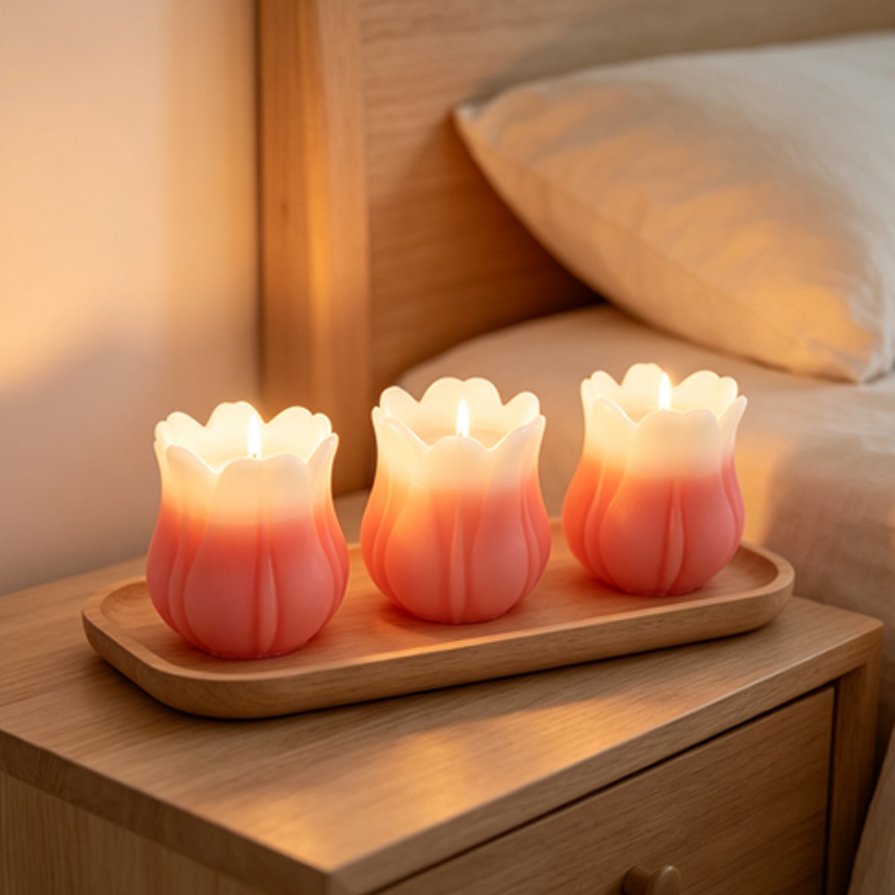
The global home fragrance industry has maintained steady growth in recent years, with container candles and mainstream cup candles occupying the core share of the mid-to-high-end consumer market. Different from traditional pillar candles and taper candles, container candles take sealed and portable containers such as glass cups and ceramic jars as carriers, featuring safe combustion, easy storage and strong scene adaptability. With the continuous upgrading of public health and environmental awareness, the market consumption logic has completely changed from low-cost practicality to green safety, aesthetic decoration and emotional experience, driving the overall technological and product iteration of the candle industry.
In professional industry segmentation, modern container candle products have formed a mature differentiated system covering four mainstream categories.Eco-friendly candles have become the basic development benchmark of the industry, abandoning traditional paraffin wax made from petroleum extraction which is prone to producing harmful fumes and non-degradable residues. Instead, they adopt renewable and pollution-free raw materials to meet global carbon reduction and green consumption policies. As the best raw material carrier for high-end environmental protection candles, soy wax candles are refined from natural soybean oil, with the industry-recognized advantages of low-temperature combustion, no black smoke, uniform wax melting and complete biodegradation, solving the core pain points of traditional candles such as health hazards and environmental pollution.
Beyond environmental performance, market demand further empowers the dual attributes of products. Scented candles rely on plant essential oil blending technology to endow container candles with emotional healing functions, covering multiple fragrance systems such as floral, woody and fruity, which are widely used in household relaxation, office decompression and hotel fragrance creation. Decorative candles, on the other hand, take the container appearance and wax body color matching as the core design, realizing the integration of daily burning function and home soft decoration aesthetic value. The organic combination of the four categories has reshaped the product structure of the container candle industry and eliminated a large number of low-end homogeneous paraffin products.
A typical customer case from a European home living retailer fully verifies the market upgrade trend. The local chain retailer used to purchase a large number of cheap paraffin cup candles for daily sales, but since 2024, its product return rate has increased and customer loyalty has declined, due to consumers’ complaints about pungent smell and black smoke during combustion. To reverse the situation, the brand adjusted its procurement strategy in an all-round way, cooperating with Chinese candle manufacturers to customize new products with soy wax as the main material. The new eco-friendly scented cup candles adopt recyclable glass containers, match low-saturation decorative color designs, and add natural plant essential oil fragrances suitable for family scenes. Within six months of launch, the brand’s candle category sales increased by 38%, and negative user reviews dropped by 90%, becoming the best-selling home fragrance product in its offline stores.
In view of the daily consumption confusion of terminal users, the industry has sorted out authoritative common questions. First, what is the essential difference between soy wax candles and paraffin candles? In addition to environmental protection and safety, soy wax has better fragrance retention, which can make the scent of scented candles release evenly and last longer. Second, are decorative container candles only for viewing? Qualified products take high-temperature resistant containers and stable wax body technology as the premise, which can meet both decorative display and normal combustion use. Third, how to judge whether a product is eco-friendly? Formal products need to provide biodegradation test reports and non-toxic certification, with no residual peculiar smell after combustion. Fourth, why do high-quality cup candles have a higher unit price? The cost of natural soy wax raw materials and essential oil formulas is higher than that of industrial paraffin, and the product safety and experience are greatly improved.
Industry analysts pointed out that the elimination of backward production capacity and green upgrading will become the main theme of the container candle track. In the future, eco-friendly and soy wax materials will be fully popularized in mid-to-high-end products, and the dual advantages of fragrance function and decorative aesthetics will become the core competitiveness of brand products. Enterprises that adhere to material innovation and scene-based design will continue to benefit from the growing global home fragrance market.